
From Shame to Safety: For those of us who didn't understand our child's neurodivergence, and caused harm they now carry every day.
I think it's so important for those of us who are able to be honest about our earlier days and our learning, to share it. So I want you to know that if you have caused harm in your parenting due to being unsupported, under resourced and uninformed, or simply because you were following scripts we had handed to us via the modelling through adults in our own lives, you are not alone.
I was harsh with my children. My two eldest children, 21 and 28, received a very different Mother than my two youngest - 15 and 11. But even my youngest children received a different version of parenting for a while.
I was punitive and dismissive and I didn't understand who they were. I didn't understand PDA despite being a PDAer myself due to my own masking, and so I responded with anger and control and defensiveness. I was unsafe. And today, and for a long while now, I see it.
I want to say something about that seeing, because I think it really matters. I'm not denying what happened. I'm not minimising it or blaming my children for how I responded to them. I'm facing it, and I believe that's where repair begins.
But here's where I got stuck for a really long time.
The shame
When I was living in shame and regret and self-punishment, I was continuing to rob my children of the parent they needed right now. Not the parent I wished I'd been all those years ago, but the one they needed today. The shame became this wall between me and my healing, and between me and the repair my children deserved. I couldn't repair from a place of collapse, and that's exactly where the shame kept me.
It was hard to face because the shame felt like it was doing something. It felt like proof that I understood the gravity of what had happened. Like if I punished myself enough, that somehow counted. But shame doesn't repair anything. It just fills the space that should hold their pain with mine instead.
Accountability is not self-destruction
I had to learn the difference between remorse and endless self-hatred, because for a long time they felt like the same thing.
There's a difference between saying "I was unsafe in ways that hurt my children, that is true, I am responsible, and I am still capable of becoming safer now" and collapsing into "I am the worst parent, I've ruined everything, I don't deserve to be in their lives." The first is accountability. The second is self-destruction dressed up as accountability, and I know how hard it is to tell them apart when the guilt is eating at every quiet moment.
What I had to come back to, again and again, was that I can hold responsibility for what happened and still be capable of showing up differently now. Both of those things can be true at the same time.
Letting my guilt become grief
This has been one of the most tender parts of the work for me. Grieving the parent I wanted to be. Grieving what my children needed and didn't get, and grieving the unsupported, drowning version of myself who couldn't do better because I didn't know what I didn't know, because I didn't have the resources, because I was parenting from my own unaddressed trauma and my own unidentified neurodivergence.
I've had to mourn that. Not fix it or explain it, just mourn it.
There's no shortcut through grief and I've tried. Every time I tried to skip it I ended up back in the shame cycle. Grief is what moves me forward. It's what softens me enough to show up differently. And it's ongoing. I
t's not something I did once and moved through. It comes back and I let it.
What repair actually looks like
Here's what I've learned, both as a parent and through the work I've done with families for many years..
My children don't need a perfect speech from me. They need repeated experiences of safety. Repair isn't a one-time conversation or a carefully worded apology that ties everything up. It's showing up, over and over, and doing it differently.
For me it has sounded like "that wasn't yours to carry, my overwhelm was never yours to carry, I'm not asking anyone to make me feel better about this, I'm owning what happened." And it has also looked like nothing more than a quieter voice. A softer response. Choosing not to escalate. Sitting beside one of my kids without an agenda and letting them lead. Sometimes it doesn't look like anything at all, just the absence of what used to be there.
Love and hurt are both true
My children love me deeply and they carry trauma from me. Both of those things are true at the same time, and I don't have to force one truth to cancel out the other. I can be a person who caused real harm and a person who is working to become safe. Holding that is uncomfortable and it's supposed to be. But it's also where the most important growth has happened for me and for them.
Not making it about me
My pain is real and I'm not dismissing that. But I learned that if every conversation with my children became about how terrible I felt, my child would end up soothing me. And that repeats the burden. I had to get to a place where I could say, to myself and to them, that I am responsible for my own care and that nobody owes me forgiveness or soothing for this. My children are not responsible for helping me feel okay about what happened. That's my work to do in therapy and in community and with the people who support me. Not on my children's shoulders.
Earned self-forgiveness
Not instant forgiveness. Earned. This isn't about letting myself off the hook. It's about asking myself each day how I'm being safer today, how I'm sitting with my shame without collapsing into it, how I'm making room for their reality, and what pattern I'm interrupting today. Self-forgiveness isn't a destination I arrive at. It's a daily practice that I earn through changed behaviour, not through deciding I've suffered enough.
The parts of me that became dangerous
This is the part of the work that has required the most courage and the most compassion for myself. The rage and the fear and the anxiety and the punishment, those parts of me were built in terror and overwhelm and unmet need. I was parenting from my own trauma, my own unidentified neurodivergence, my own conditioning. Understanding that doesn't excuse it but it does allow me to change it.
I've had to say to those parts of myself: you hurt my children, and I won't allow this again. I know you were built in pain. I'm not abandoning you either. We have some work to do.
When the shame hits hard
For the days when it all feels like too much, when the memories flood in and the shame threatens to pull me under, this is what I come back to:
I believe my child about the hurt. I take responsibility. I cannot change the past. I can face it and I can grieve it. I can repair what is repairable. I can become safer. That is how I love them now.
If this resonated
This is the kind of work I explore deeply in my webinars. If any of this felt familiar, these three recordings were created from the same place.
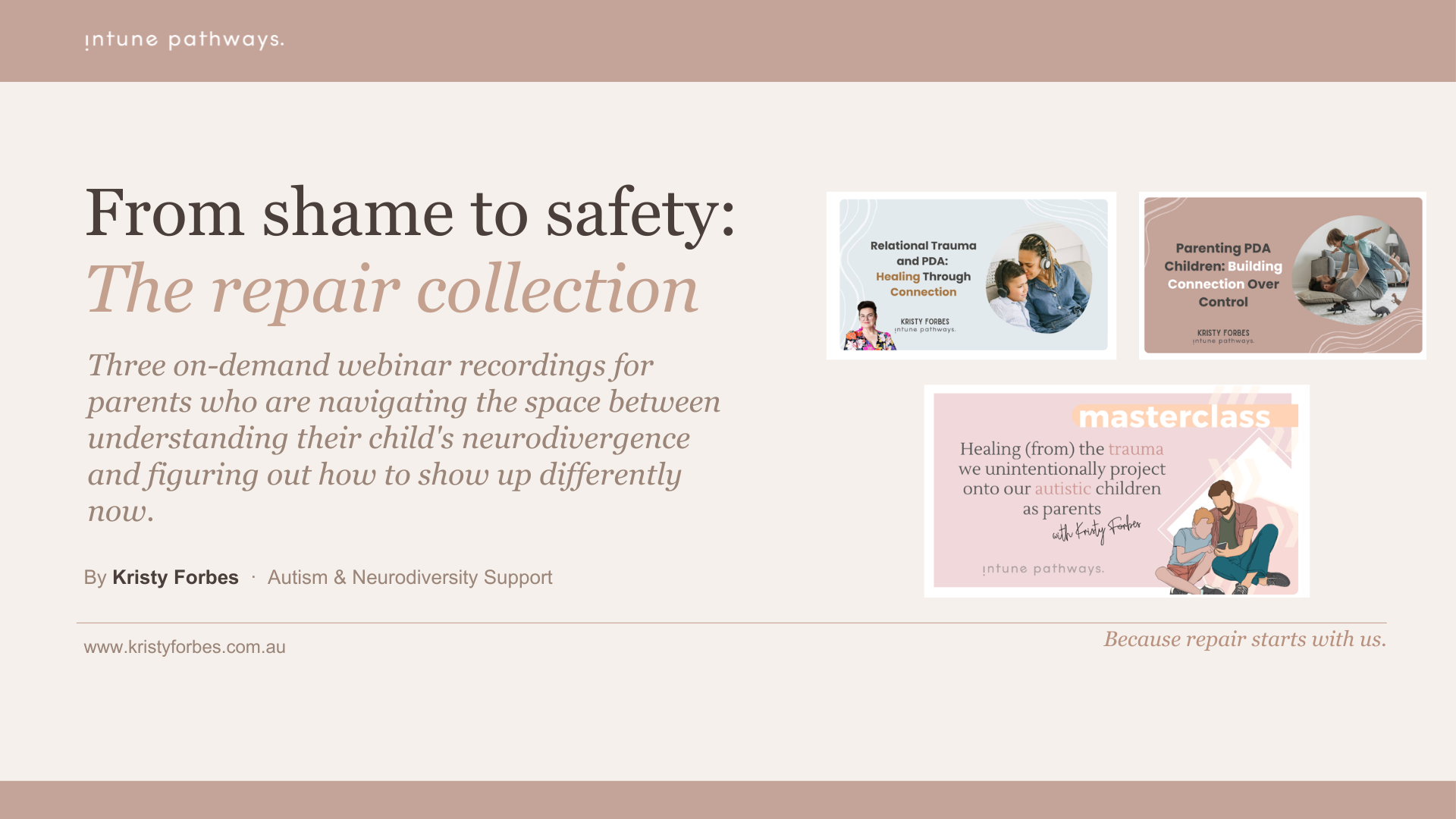
From Shame to Safety: The Repair Collection
Three on-demand webinar recordings for parents who are navigating the space between understanding their child's neurodivergence and figuring out how to show up differently now.
- Relational Trauma and PDA: Healing Through Connection
Understanding how relational trauma develops in PDA families, and how we begin to rebuild trust and safety through connection rather than control. - Parenting PDA Children: Building Connection Over Control
Moving away from conventional parenting approaches and toward a relationship-centred way of being with our PDA children. - Healing (from) the Trauma We Unintentionally Project onto Our Autistic Children as Parents
A deeply personal exploration of how our own trauma, conditioning, and unidentified neurodivergence shapes our parenting, and how we begin to heal from it.
Each webinar is $65, or access all three as a bundle for $150 (saving $45). They're recorded, so watch in your own time. Pause when you need to. Come back as many times as you need. They each come with a transcript, slides and a certificate of completion.
Because repair starts with us.
Kristy